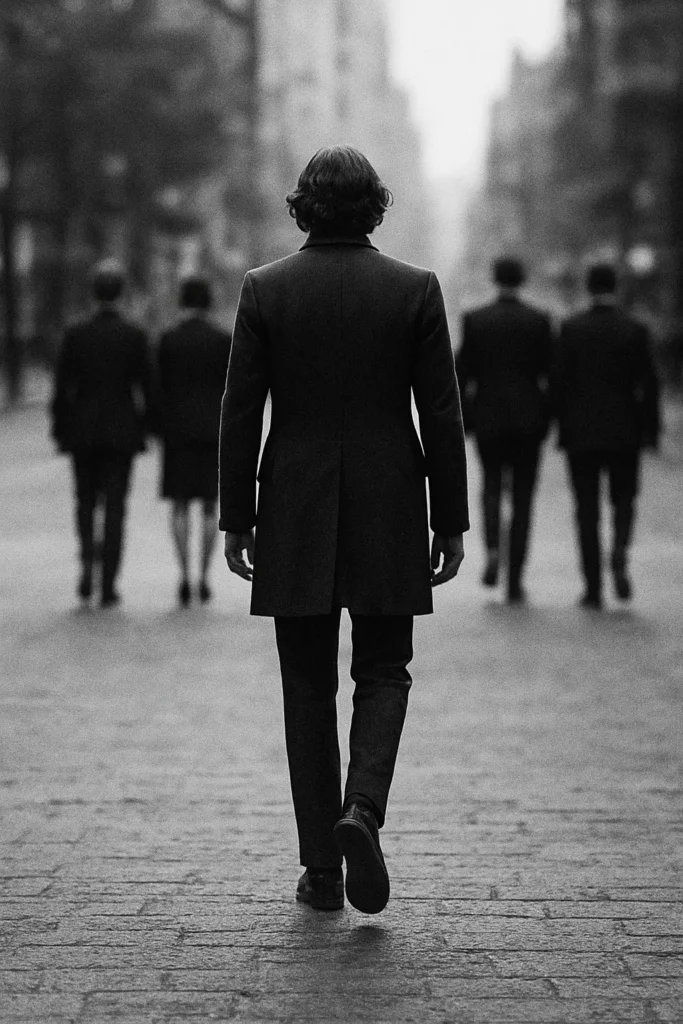
One is constantly told to follow a good example. It is a piece of advice so utterly devoid of originality that one immediately suspects its virtue. The world, it seems, is a vast, uninspired gallery of people trying to be like someone else. They mimic a hero, a philanthropist, or, most tragically, a person of moral character. And what is the result? A universe populated by second-rate imitations and fourth-rate sincerity. The very idea of a ‘good example’ is an insult to the individual. It suggests that one’s own imagination is insufficient, that one’s own impulses are suspect, and that the beautiful, dangerous path of self-invention must be abandoned for the well-trodden, utterly tedious road of mimicry. A man should not be a copy; he should be an original. He should not live a life that someone else has already lived better. He should live one that has never been lived before.
The Tyranny of the Paragon
To be a truly interesting person is to be a bad example. It is to be a delightful warning to others, an exquisite proof that life, when not constrained by the dull virtues of convention, can be a work of beauty and art. The hero is merely a figure to be admired from a distance; the artist is a force to be reckoned with up close. Let us, therefore, not aspire to be the heroes of our own stories, but rather, the villains—the magnificent, charming, and utterly unprincipled villains who refuse to follow anyone’s lead but their own. The greatest artists, writers, and thinkers of any age were not those who conformed to the expectations of their time, but those who defied them with a glorious and unapologetic flourish. Think of those great minds who chose to live as they pleased, who prioritized their own unique vision over the banal expectations of society. To follow a ‘good example’ is to resign oneself to a life lived in the shadow of another’s achievements, a life of perpetual imitation rather than profound creation.
The Peril of a Good Example
The pursuit of a ‘good example’ is, in its essence, a form of spiritual cowardice. It is a retreat from the glorious, and often terrifying, responsibility of creating oneself. To model one’s life on another’s is to admit that one lacks the imagination to invent one’s own. This, of course, is a central pillar of Oscar Wilde’s philosophy on living. One’s life, in my view, is the most significant work of beauty and art one will ever produce. Why, then, would one choose to plagiarize it? A life lived by the book—and worse, by someone else’s book—is a life that has forfeited its claim to originality. The true individual does not seek to be praised for their conformity, but to be celebrated for their magnificent divergence. We are not here to be reflections; we are here to be luminaries, each with our own distinct and brilliant light. To follow a path laid out by others is to walk with a limp, forever bound by the limitations of those who have gone before. The man who is a ‘good example’ is merely a monument to the past, while the man who is a ‘bad example’ is a promise of the future.
On the Virtues of Disobedience and the Cultivation of the Self
It is through disobedience that progress has been made, both in art and in life. The man who conforms is a mere cog in a machine, a predictable outcome of a predictable process. But the man who disobeys, who dares to be an exception rather than a rule, is a force of nature. He introduces a thrilling element of chaos, an unpredictability that is the very lifeblood of creativity. To cultivate the self is a far nobler pursuit than to imitate others. It is a solitary journey, a delicate process of pruning and nurturing one’s own unique personality until it blossoms into something truly magnificent. A man should be a secret, a mystery that unfolds slowly and with great theatricality, not a dull fact to be memorized and recited. The peril of a good example is not merely that it leads to mediocrity, but that it robs the world of a potential masterpiece: the self-made man, forged not in the fires of conformity, but in the crucible of his own singular imagination. The truly interesting person is a glorious experiment, a walking, talking defiance of all that is common and conventional.


Leave a Reply